Pilot preparation
The first installations are being prepared. Operating and repayment histories are not yet available.
Sources Finance · Financing infrastructure in development
Sources.Africa is preparing its first biogas installations in Cameroon. Sources Finance is the proposed mechanism for funding eligible systems upfront and recovering capital through affordable lease or service payments. We are now seeking design and catalytic partners to test the operating model before building a financeable portfolio.
Concept stage: no financed assets, committed investment capital or verified project emission reductions are reported. Facility terms and legal structure remain under development.
Current stage
The first installations are being prepared. Operating and repayment histories are not yet available.
No investment commitments are announced. Partner outreach and feasibility design come first.
A dedicated asset-finance vehicle is proposed. Its jurisdiction, manager, licenses and contractual relationships remain to be agreed.
In the field, as designed
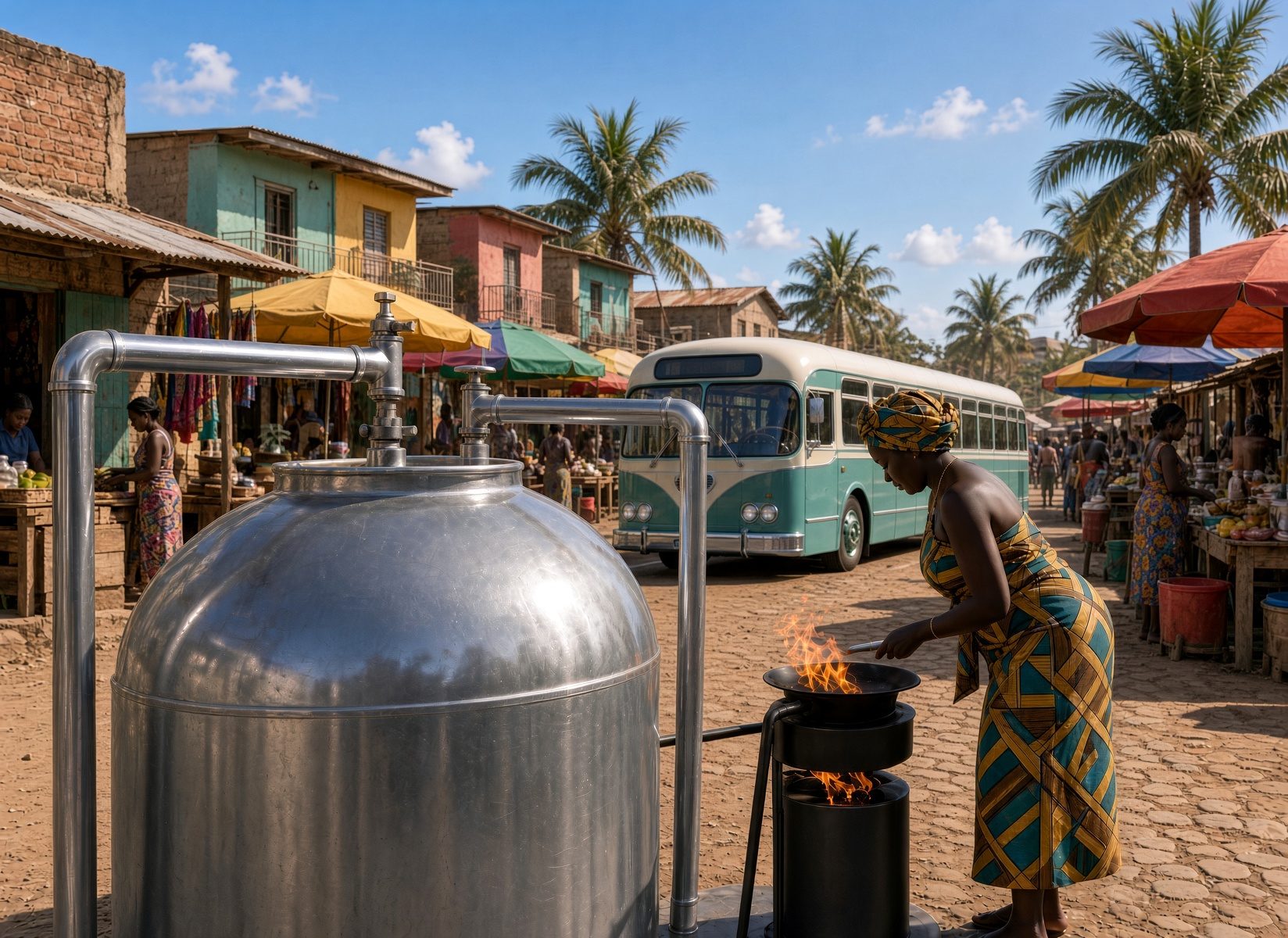
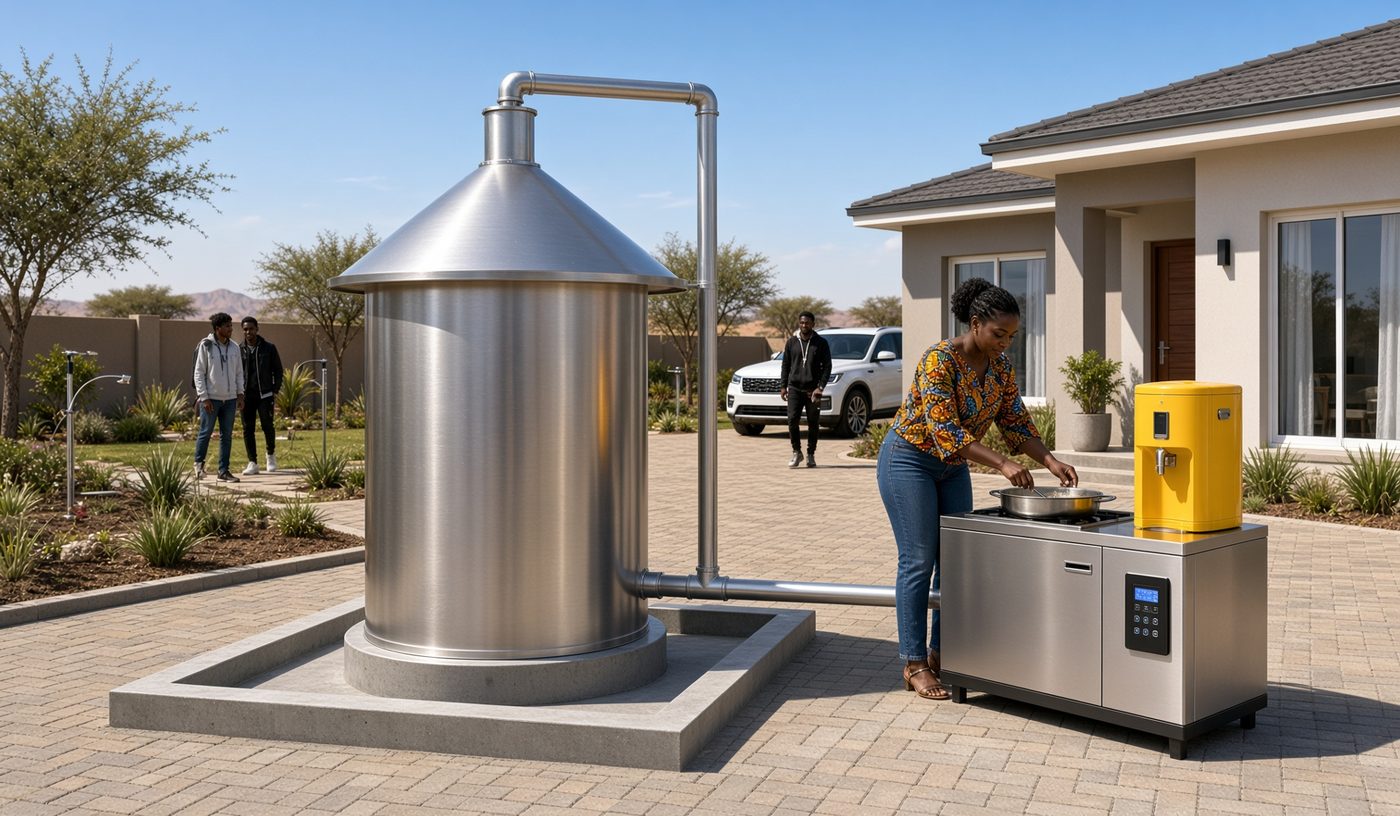
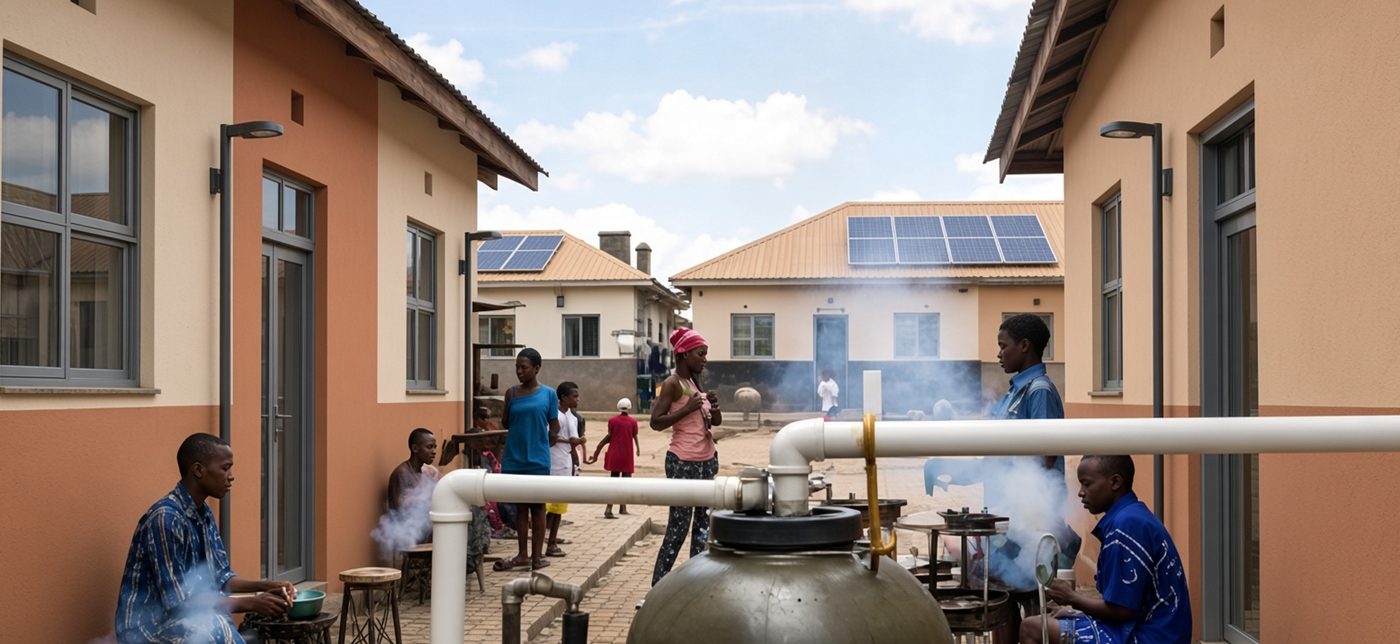
Illustrative renderings of the installation model: a stainless digester, pipework, and cooking points at household and shared scale. They show the design, not a deployed site.
What Sources provides
The proposed operating model links equipment, maintenance and evidence to asset finance. These are the capabilities to validate through the first pilot, not services already operating at scale.
01
Select suitable sites and equipment, assess feedstock and commission safely after funding and permissions.
02
Train local operators and test maintenance, spare parts and service reliability.
03
Record usage, affordability, environmental performance and the cost of servicing each asset.
04
Use verified evidence to structure eligible assets into a portfolio. Contracts and financing terms remain to be developed.
In motion
Short illustrative clips. They are not measured performance data; verified results are published only after the evidence gates below are met.
Who it serves
Each host type has its own installation, its own way of paying, and its own path to local ownership. The financing structures below are being explored. None is open today.
Homes
Household biogas and clean-cooking systems that replace wood, charcoal or LPG.
How it could be financed: Lease-to-own and pay-as-you-use structures are being explored. Terms will be set only after field evidence and affordability testing. Sources does not promise that every household will spend less.
Hospitals
Clean energy and cooking systems for clinics and health centres, with organic-waste processing on site.
How it could be financed: Infrastructure-service and performance-linked contracts are being explored, with a facility funding installation upfront while the host pays over an agreed term.
Schools
Clean cooking for school kitchens and energy for school facilities, with waste managed locally.
How it could be financed: Service agreements and lease-to-own structures are being explored, subject to the school authority and local partners.
Public entities
Organic-waste systems for municipal markets, public kitchens and waste sites.
How it could be financed: Infrastructure-service, lease-to-own and performance-linked contracts are being explored. After the agreed term, ownership can transfer locally. Local ownership remains the objective.
Agriculture
Biogas for energy and digestate for organic fertiliser, where that value is demonstrated.
How it could be financed: Repayment may draw on fertiliser revenue and productive-use energy, only once validated for the specific deployment.
Communities
Shared installations for community halls, markets and waste collection points.
How it could be financed: Shared-ownership and portfolio participation are being explored. Repayable participation would be introduced only through an appropriate legal and regulated structure.
How financiers connect
Capital from foundations, development institutions and, later, regulated community or institutional investors would enter a dedicated facility. The facility would finance qualifying installations for homes, hospitals, schools and public entities. Regular repayments would return to the facility and could be reused. No facility is open for subscription today.
Financiers: foundations, development institutions and, later, regulated investors
Proposed Sources Finance facility
Homes, hospitals, schools, public entities
Regular repayments would return to the facility and could be reused.
How it moves
01
Grants and catalytic funding support first installations and demonstration systems.
02
Performance, affordability, maintenance and environmental outcomes are measured.
03
Validated installations can become eligible for lease, service or asset-finance structures.
04
Repayments would return to the facility and could help finance further installations.
Pathway 1 · Now
Sources is seeking catalytic partners now. Early-stage capital would fund first-of-kind household, health and public-institution installations before they are ready for commercial financing. The purpose is to learn whether an installation is reliable, useful, affordable and ready to be repeated.
Pathway 2 · Proposed
Once a deployment model has been validated, Sources intends to make standardized installations financeable through a dedicated climate-asset facility. An eligible host could make regular lease, service or infrastructure payments instead of paying the full capital cost upfront. The institutional name of the proposed vehicle is the Sources Africa Community Climate Asset Finance Facility.
Our current ask
We seek partners for feasibility work, prototype funding and financial instrument design. Grants could support evidence generation; any concessional debt would need explicit repayment terms and risk assessment. No capital commitment, return or public subscription is offered here.
Feasibility
Before financing is offered, the pilot must test these assumptions and publish the resulting evidence.
What a household, clinic or school can pay each month, tested on the ground with the people who would pay.
Installation uptime, maintenance cost and time to repair, recorded for every system.
Collection rates through mobile money, bank transfer or a cash agent, measured over real months.
Fuel saved, fertiliser value and productive use, measured rather than estimated.
What it costs to track one installation's records, payments and milestones. This is the cost a shared ledger is intended to reduce, and it is tested before any claim is made.
Repayment
The proposed facility would collect contractual lease or service payments from eligible hosts. Avoided fuel spending can support affordability but is not itself cash received by the facility. Digestate, waste fees and productive-use revenue count only when a contract and field evidence support them. Carbon revenue is excluded from the core repayment case.
Wood, charcoal, LPG or other fuels the host already buys.
Energy-service payments and institutional infrastructure fees.
Waste-management savings or fees, and revenues from digestate or organic fertiliser.
Revenues from energy used in local economic activity.
Only where independently verified and appropriate. This stream is supplementary.
Illustrative cash flow
A proposed operating waterfall for design discussions. It is not a term sheet. Payment priority, reserves, returns and loss allocation would be agreed with a regulated financing partner.
Eligible hosts would pay agreed service or lease charges in local currency through a licensed payment provider.
Contracts would provide for essential operating costs, maintenance and a replacement reserve so repayment does not undermine reliable service.
Remaining cash would meet agreed debt or investor obligations. Catalytic loss protection, if secured, would have explicit limits and triggers.
Surplus could support further qualifying installations. Local ownership would transfer only under the agreed contract and after its conditions are met.
Investment design
Risk controls below are proposed design requirements. Guarantees, insurance, currency protection and independent verification have not been secured.
Validate feedstock supply, water use, gas yield and maintenance capacity; stop or resize sites that cannot operate safely.
Test total costs, seasonal income and collection behaviour. Define consumer protection, hardship procedures and fair local-currency terms.
Match financing to local-currency cash flows where possible. Assess FX exposure, procurement authority and institutional payment delays before underwriting.
Measure methane leakage and baseline fuel use; assess digestate safety, land rights and workload. Publish net climate results only after a validated methodology.
Separate operator and vehicle accounts; agree conflicts procedures, reporting and independent review. Diversification is a design objective, not an existing protection.
Separate financing records from health data. Research requires consent, ethics review and qualified local partners; an asset ledger does not prove a climate or health outcome.
Route to investment readiness
Each gate ends with a documented decision: proceed, change the design or stop. Thresholds will be set with partners before the pilot begins.
Site rights, feedstock, host demand, technical specifications, costed procurement and documented partner responsibilities.
Commissioning records, safe operation, service uptime, affordability, fuel substitution and a baseline for net climate impact.
A costed cash-flow model, payment evidence, downside scenarios, consumer protections, independent legal review and proposed capital terms.
Approvals, signed financing and service agreements, reporting controls and explicit investment decisions before new capital is deployed.
Requested partner contribution: climate-finance structuring, unit economics, legal and regulatory design, verification methods and catalytic pilot capital. A website alone does not establish investment readiness.
Participation
Sources intends to explore ways for citizens, diaspora communities, impact investors and institutions to participate in financing verified infrastructure. Early prototype participation may take the form of grants or other catalytic contributions. Future repayable opportunities would be introduced only through appropriate legal and regulated structures. The long-term objective is that capital from many participants finances a diversified portfolio, rather than exposing a participant to a single household or project.
Why a shared record
A shared asset register could link equipment, commissioning, maintenance and payment evidence. We will first compare it with a conventional database on cost, data quality and auditability. A blockchain or token is not required for the financing model. Any later ledger would hold only non-sensitive proofs; personal and health information would remain off-chain. Hosts would pay in local currency through licensed providers, with no crypto wallet required.
Future structure
The architecture may combine catalytic capital, to support prototypes and absorb early risk; community and impact capital, to finance diversified portfolios of proven installations; and commercial or institutional capital, to scale those portfolios once operational and repayment evidence exists. Guarantees, first-loss structures and results-based climate finance may be evaluated where they can responsibly mobilize additional private capital. The final architecture will be developed with financial, legal, regulatory and climate-finance partners. Investment capital is intended to sit in a dedicated vehicle, separate from the operating account.
To support prototypes, absorb early risk and validate new installation models.
To finance diversified portfolios of proven installations, only through a regulated structure.
To scale standardized portfolios once operational and repayment evidence exists. Guarantees, first-loss structures and results-based climate finance may be evaluated where they can responsibly mobilize additional private capital.
Boundary
The objective
One successful prototype should create evidence. Evidence should make an installation financeable. A financeable installation should generate repayments. Repayments should finance the next installation. That is how local infrastructure can become a scalable asset class without losing local ownership.
Pipeline
Nothing in this table is a contracted installation. Sources does not yet report a financed asset. Names below show the kinds of hosts the facility is being designed for.
| Reference | Kind | Place | Status |
|---|---|---|---|
| Illustrative | Household biogas demonstration | Cameroon — site to be validated | Prospective. Not contracted |
| Illustrative | Community health centre | To be selected with partners | Prospective. Not contracted |
| Illustrative | Municipal market organic-waste system | To be selected with partners | Prospective. Not contracted |
For financiers and partners
Sources welcomes a conversation with foundations and catalytic capital, public institutions, communities, equipment and installation partners, and future finance partners. This form does not create an account, a commitment, or an offer.
Catalytic capital for the prototype and first-loss support.
Municipalities, hospitals, schools and other institutions that may one day host an installation.
A conversation about the facility. Not a subscription and not a promise of a return.
Sources Finance is under development. We welcome conversations with climate-finance partners, public institutions, communities, foundations and impact investors.
Become a conversation partnerSources Finance is a financing mechanism under development. Nothing on this page is an offer, a solicitation, or a recommendation to buy or subscribe for a security or another financial product. Sources.Africa does not provide medical advice. Claims remain labelled by stage.