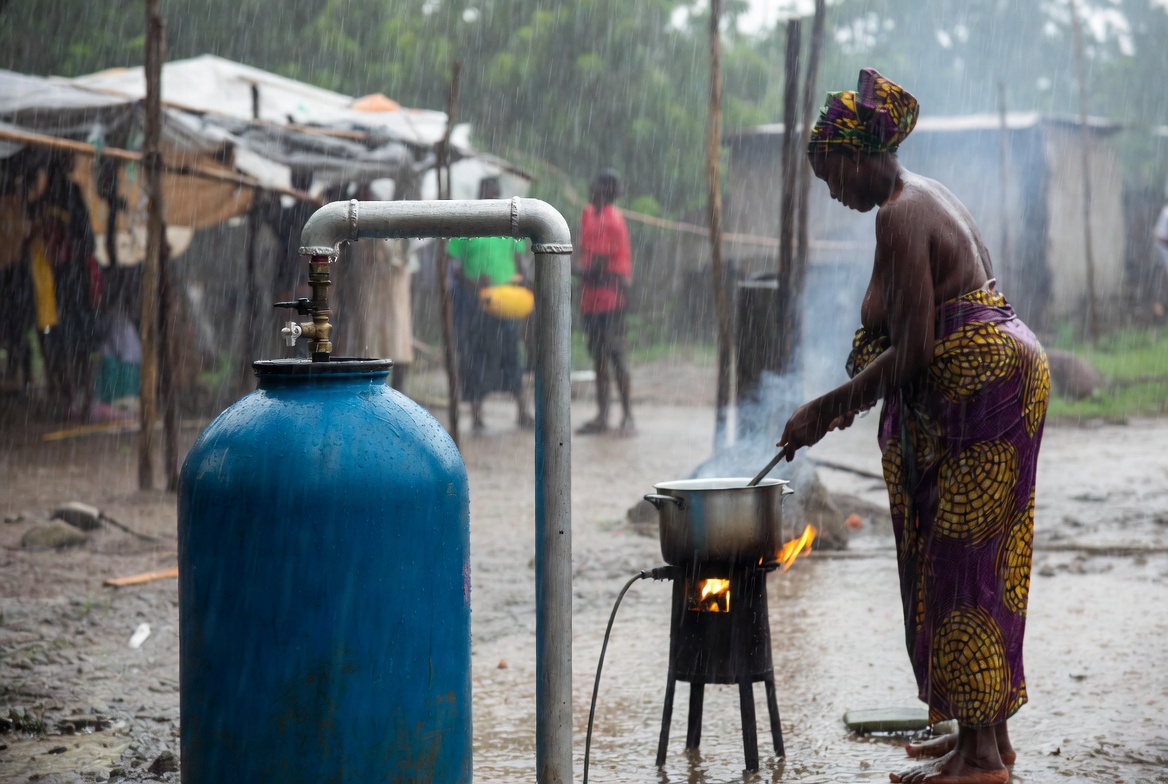
Health & Clean Air
Designed to reduce household smoke exposure and support earlier action for people vulnerable to chronic respiratory illness - not a claim of proven clinical outcomes yet.
Primary pilot pathway
Poor household air quality to earlier respiratory response
The first evidence pilot focuses on: poor household and community air quality leading to chronic respiratory vulnerability, then earlier identification, prevention, follow-up and referral - not diagnosis or treatment by Sources.Africa.
Priority households: wood or charcoal users; children in smoke-exposed homes; older adults and people with asthma or other chronic respiratory conditions. Sleep apnoea remains the founding story, not a treatment claim.
Why this is a health-system problem
Smoke, heat and grid interruption hit women, children, older adults and people with respiratory vulnerability hardest. Clean cooking alone is not enough if risk signals never reach a health actor.
What is new about the Sources.Africa model?
Biodigesters, sensors and community health workers exist separately. The innovation is running them as one locally operated system.
| Conventional biogas programme | Sources.Africa model |
|---|---|
| Measures units installed | Measures exposure reduction |
| Focuses mainly on fuel | Connects energy, air quality and health response |
| No clinical referral pathway | Community-health-worker and clinic workflow |
| Technical monitoring only | Technical, environmental and health indicators |
| Installation-focused | Installation, adoption, maintenance and health action |
- 1Clean-energy infrastructure that reduces exposure at source
- 2Continuous or periodic environmental sensing (PM2.5, CO, heat, humidity)
- 3Identification of vulnerable households
- 4Risk thresholds and alerts (partner-approved protocols)
- 5Community-health-worker follow-up
- 6Referral to a health facility
- 7Maintenance, adoption and health-impact monitoring
- 8Local ownership and revenue from energy or digestate
Reduce - Sense - Respond
One integrated pathway, still in pilot design.
1
Reduce
Replace wood and charcoal with clean biogas cooking; optional power for essential services.
2
Sense
Measure PM2.5, carbon monoxide, temperature and humidity so risk becomes visible.
3
Respond
Community health workers and partner facilities act earlier - screening, advice and referral.
From climate-health signal to action
Illustrative matrix only. Final thresholds must be approved by clinical and research partners - we do not improvise medical cut-offs here.
| Signal | Threshold approach | Action |
|---|---|---|
| Elevated indoor PM2.5 | Protocol-defined exceedance | Household advice and stove-use review |
| Dangerous carbon monoxide | Safety threshold exceeded | Immediate warning, ventilation, equipment inspection |
| High heat and humidity | Locally defined risk level | Check vulnerable households and clinic continuity |
| Repeated smoke episodes | Multiple exceedances | Community-health-worker visit |
| Respiratory warning signs | Validated screening result | Referral to partner facility |
| Grid interruption affecting essential services | Reported outage | Local resilience or referral protocol |
This is an operational design draft for partner review - not medical advice and not a finished SOP.
What we do not claim
Sources.Africa does not diagnose, treat or cure disease - including sleep apnoea. We do not replace clinical care. We reduce an exposure pathway and help local health actors act sooner.